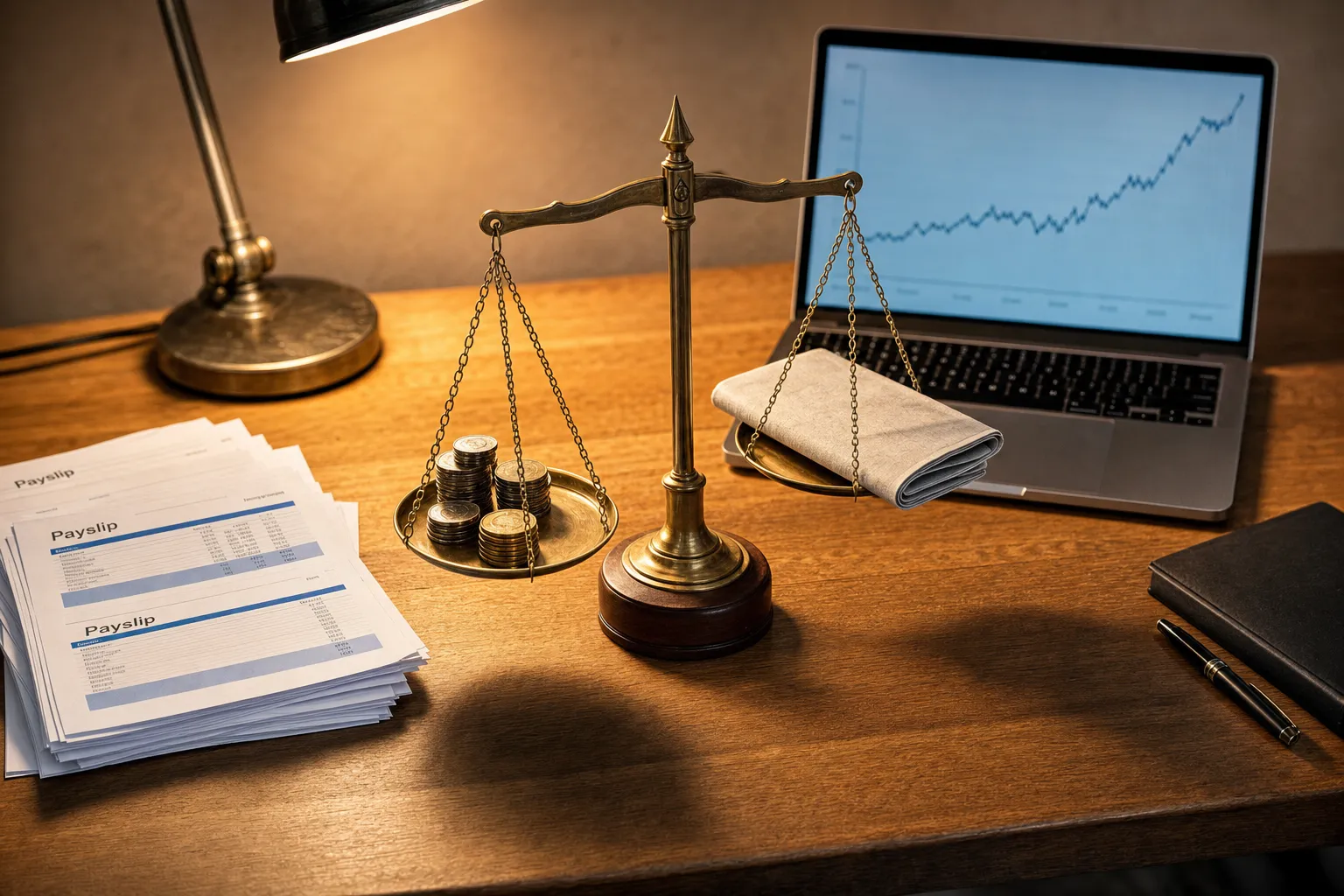
Anthropic's new economic model says AI could add trillions of dollars to the US economy by 2030. It could also cut the wages of the same knowledge workers doing the AI-augmented work. For an Australian law firm, accounting practice or consultancy, that is a warning to change how the business runs now, not a forecast to wait out.
On 9 September 2026, Anthropic's Economics team posted on X that it was sharing "a new model of how AI might affect economic growth, jobs, wages, and more by 2030." The post invited people to explore the scenarios and compare their own predictions against more than 10,000 surveyed Americans. It is one of the most detailed public attempts yet to put numbers on what AI adoption actually does to a labour market, not just to a company's output.
What did Anthropic's Economics team actually build?
Anthropic released an interactive tool called the Econ Scenario Explorer on its Anthropic Institute economic scenarios page, alongside a companion working paper, Economic Scenarios for Transformative AI. Rather than predicting a single future, it models US GDP, wages and unemployment through 2030 under three named scenarios: modest, substantial and extreme.
The model works task by task, not job by job. Every job is treated as a bundle of tasks. For each task, AI can do one of four things: help a person complete it faster or better, or do the whole task itself. It can also leave the task alone, or create a brand-new task that did not exist before. That distinction matters. A bookkeeper's job does not vanish. The individual tasks inside it — bank reconciliation, first-pass data entry, chasing overdue invoices — get reassigned between the person and the AI, task by task.
What are Anthropic's three 2030 scenarios?
Each scenario carries a different economic weather forecast for 2030:
| Scenario | GDP vs. no-AI path | Knowledge-worker wages | Unemployment | Labour's share of income |
|---|---|---|---|---|
| Modest | +1.6% (US$34.1T) | Essentially flat | Within historical range | ~59.4% (from ~60%) |
| Substantial | +8.3% (US$36.3T) | Flat; other workers gain modestly | ~5% | 56.1% |
| Extreme | +32.4% (US$44.4T) | Down 11.5%; other wages up 33.6% | 17.9% (cognitive), 11.9% (economy-wide) | 45.2% |
Anthropic does not pick a winner among the three. The gap between them is the point. The same technology can produce a mild uplift or a genuine labour-market shock, and which one arrives depends heavily on how fast businesses actually adopt AI and how policy responds. Techstrong.ai's coverage of the release put it plainly: these are not predictions. What the economy looks like in 2030 depends on what AI can do and how companies and workers choose to adopt it.
What happens to professional-services wages and jobs?
This is where the model gets uncomfortable for the exact audience reading this. "Knowledge workers" — the model's term for people doing cognitive, largely desk-based work — are the group whose wages stagnate in the substantial scenario and fall in the extreme one. Anthropic's own analysis suggests displaced knowledge workers would need to shift toward occupations that are harder for AI to touch, such as electricians or nurses.
For an accounting practice, a financial advisory firm or a consultancy, this is not an abstract macro trend. It is a description of the exact tasks — research, drafting, first-pass analysis, routine client correspondence — that make up a large share of chargeable hours in professional services. The scenario split shows what is at stake: automate those tasks and keep the value inside the firm, or watch the market compress the price of that work regardless. Accounting, financial advice and consulting are exactly the "knowledge work" the scenarios describe, which is why the split matters most here.
What did 10,000 Americans predict about AI's impact?
Anthropic paired the model with a survey of more than 10,000 Americans, run via Morning Consult in August 2026. The survey asked what people expected AI to do to growth, jobs and their own prospects of finding new work. The typical respondent's predictions landed close to the substantial scenario: GDP about 10% higher by 2030 than without AI, and unemployment around 5%. Roughly one in ten respondents held views closer to the extreme scenario.
That is a useful sanity check, not a prediction to import wholesale. It tells us the substantial scenario is the outcome most people already expect: meaningful growth, flat knowledge-worker wages, a modest unemployment bump. Few respondents are betting on the mild "AI as ordinary technology" case.
Does this US model apply to Australian firms?
Partly, and it is worth being precise about which parts. Anthropic's model is calibrated on US labour-market data, and Australia's institutions differ in ways that matter. Modern awards, enterprise bargaining, and unfair dismissal protections make it harder for wages and headcount to move as sharply here as the extreme US scenario describes. There is no published Australian equivalent of this model, so treat any Australia-specific number as a translation, not a citation.
What does transfer directly is the underlying mechanism. The model's core idea is that AI reassigns tasks within a job, not whole jobs at once, and that dynamic is not specific to US labour law. An Australian financial adviser's first-pass statement-of-advice drafting is just as exposed to task-level automation as an American analyst's spreadsheet work. The institutional buffers may slow how fast wage and employment effects show up here. They do not switch the mechanism off.
What should you actually do about this before 2030?
Three things, regardless of which scenario turns out to be closest to reality.
Audit your own task mix, not your job titles. Sit down with each role in the practice and separate routine, rules-based cognitive tasks (data entry, first-pass drafting, standard client intake) from judgement-heavy, relationship-based work. The first category is what the model says is exposed; the second is what stays valuable in every scenario Anthropic modelled.
Treat AI adoption as capacity capture, not a headcount decision made under pressure. Firms that redeploy the hours AI frees up toward higher-value client work keep the upside on their own side of the ledger. That is what our AIOS methodology is built to do: connect a firm's existing tools into one system, so freed-up hours go to clients, not to competitors demanding lower fees. We have seen this pattern across the client work we have run for professional-services firms in Sydney, including through our Sydney AI automation practice.
Do this planning now, while it is a strategic choice, not a defensive scramble once wage pressure or client fee expectations force the issue. A firm that has already mapped which tasks it automates and which it protects is negotiating from strength. A firm that waits until the extreme scenario looks plausible is negotiating from behind.
Anthropic's model does not tell any single firm what will happen to it by 2030. It tells us the range of what could happen, and that the range is wide enough to reward firms that plan early. If you want help mapping which tasks in your practice are exposed and which AI moves actually protect your margin, book a free initial AI consultation. We will walk through it together.